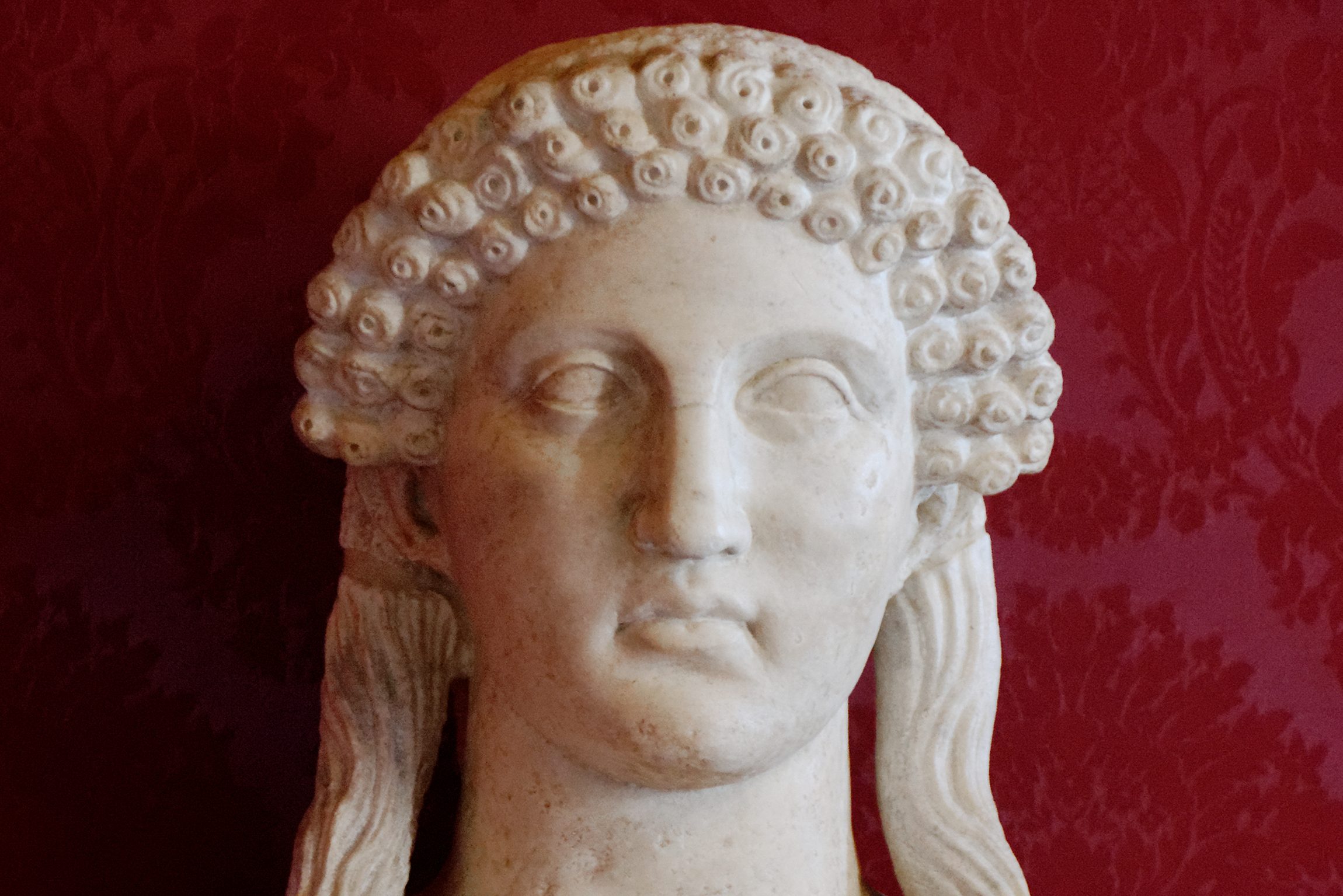
Behind the Diaries: Exploring the Real Sappho
Welcome to Behind the Diaries!
This is going to be a behind-the-scenes series where I take the opportunity to be the ancient history nerd that I am and break down the latest ‘Very Ancient Diary’ short story. I put a lot of research into each one and thought I’d share some of it with you in case you’d like to learn more about the real people that inspired the stories.
In Behind the Diaries we’re going to be looking at the historical context of each short story and discussing which events actually occurred, which characters are based (loosely or otherwise) on real historical figures and any other nerdy details I managed to squeeze into the diaries…
Oh, Muses…
Sappho begins her diary by invoking the Muses, a characteristic feature of ancient epic poetry. This is partly because she used some features of epic poetry in her surviving work, but also because Sappho is in a very dramatic mood! Examples of this invocation can be seen in the openings of Homer’s Odyssey and Iliad (along with works wishing to convey some of the same epic style, such as Ovid’s Metamorphoses).
I imagined that she might see the Muses almost as friends at this point and address her diary as if speaking to them directly. Unsurprisingly, there were very few female poets in Greece during Sappho’s time, so perhaps she feels these mythological women are some of the few that might understand her position.
Sappho’s professed title as the ‘Δέκα Μοῦσαι’ – meaning the ‘Tenth Muse’ – was actually given to her, although in reality only after her death. For the purpose of the story, however, I decided to have it be a contemporary title.
Miasma: Always a Good Excuse
When Sappho is making a mental list of possible reasons to prevent her seeing Alcaeus, the first one she comes up with is miasma. This was a real concept in ancient Greece and is the idea that one can become ‘infected’ by a sort of spiritual pollution.
Someone infected by miasma was believed to bring bad fortune to their household and anyone who came into contact with them. Pollution could cause all manner of misfortune – natural disasters, murder, death, the list goes on.
Believed sources of miasma were menstruating women, women who had just given birth (there’s a bit of a theme here…), amongst other sources such as dead bodies. So, in the story, Sappho has been using this belief to her advantage, but unfortunately fears this would be one too many times to be convincing.
Was Alcaeus Really That Annoying?
Alcaeus was indeed a real poet, contemporary to Sappho, but there is no evidence indicating whether they ever met each other. As he was also from Lesbos, however, it seems likely that they may have at least crossed paths. Unfortunately, their dynamic in Sappho’s diary was entirely made up for my own entertainment.
The real Alcaeus was actually quite esteemed by later poets, especially Horace, and wrote poems on a number of topics. One of my favourites is a collection perhaps designed for symposia, which extensively discuss the god Dionysus and wine. According to Horace, Alcaeus also wrote erotic poems for young men, so perhaps Sappho wasn’t the only one interested in the same sex.
Although there is no reason to suppose Alcaeus was actually as annoying in real life as in the story, he was perhaps quite an extravagant, revelry-focused man, as suggested by the nature of much of his poetry.
Cleis: Sappho’s Daughter?
Cleis has been a topic of much debate within scholarship surrounding Sappho. She is mentioned twice by name in Sappho’s poetry. Some scholars have suggested Sappho’s mother was called Cleis, not her daughter, and others have said that she was actually one of Sappho’s lovers. The most convincing theory, however, seems to be that Cleis was her daughter.
Cleis is mentioned in fragments 98(b) and 132. Here is a translation of 132:
‘I have a beautiful child, her form like golden flowers, beloved Kleïs, whom I would not trade for all of Lydia or lovely . . .’ (trans. by Diane J. Rayor and André Lardinois)
This translation, at least, suggest Cleis was indeed Sappho’s daughter. In ‘The Very Ancient Diary’ I opted to make Cleis her adopted daughter, so that I could have the history of Sappho and Callista as backstory (a character who is purely my own invention, although Sappho certainly seems to have had female lovers).
Sappho: The Poet and Enigma
Besides one surviving complete work and a few fragments, we actually have very little remaining of her work and hardly any evidence for what her life might have been like on Lesbos. We know that she was a musician and poet, but there is no record of her parents’ names, she may have had brothers and she may have educated young women. I wish we had more information about her!
What is without doubt, however, is the lasting impact of her work. Proceeding ancient poets were greatly influenced by her lyric poetry and she remains a legend today. She is the origin of the popular terms ‘sapphic’ and ‘lesbian’, relating to female homosexuality, and her poetry continues to move and inspire modern readers. If you have yet to pick up Sappho’s work, I have listed a few collected translations below, along with some publications about her life and the legends that have surrounded Sappho for millennia.
Suggested Further Reading on Sappho
Carson, Anne, If Not, Winter: Fragments of Sappho (New York: Vintage Books, 2002)
Freeman, Philip, Searching for Sappho: The Lost Songs and World of the First Woman Poet (New York; London: W. W. Norton & Company, 2016)
Reynolds, Margaret, The Sappho History (New York; Hampshire: Palgrave Macmillan, 2003)
Bibliography
Rayor, Diane J. & André Lardinois, Sappho: A New Translation of the Complete Works (Cambridge: Cambridge University Press, 2014)


Leave a Reply